
Table of Contents
Digital marketing is changing faster than ever. New technologies, changing customer expectations, artificial intelligence, social media platforms, and new search experiences are transforming the way businesses connect with their audiences.
For businesses, keeping up with digital marketing trends is no longer simply about following what is popular. It is about understanding where customers are spending their time, how they search for information, what influences their buying decisions, and which technologies can improve the customer experience.
In 2026, artificial intelligence is playing a particularly important role in marketing. Search is becoming more conversational and multimodal, while video, creators, personalization, and social commerce continue to influence how people discover brands and products. Google describes this shift as a move toward consumers searching, streaming, scrolling, and shopping across increasingly connected experiences.
This article explores the most important digital marketing trends businesses should understand in 2026 and explains how marketers can adapt their strategies.
What Are Digital Marketing Trends?
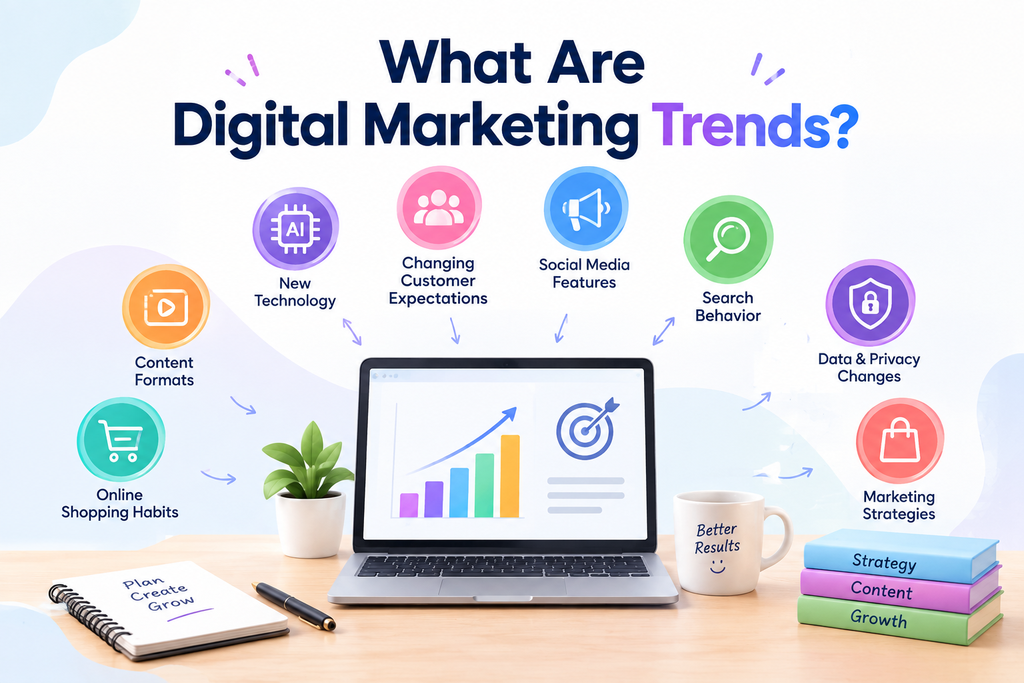
Digital marketing trends are emerging changes in technology, consumer behavior, platforms, content formats, and marketing strategies that influence how businesses promote their products or services online.
A trend can develop because of:
- New technology
- Changing customer expectations
- New social media features
- Changes in search behavior
- Artificial intelligence
- Data and privacy changes
- New content formats
- Changes in online shopping habits
Understanding digital marketing trends helps businesses identify new opportunities while avoiding outdated strategies.
However, businesses do not need to follow every trend. The most useful approach is to identify trends that match the audience, industry, budget, and business objectives.
Top Digital Marketing Trends in 2026
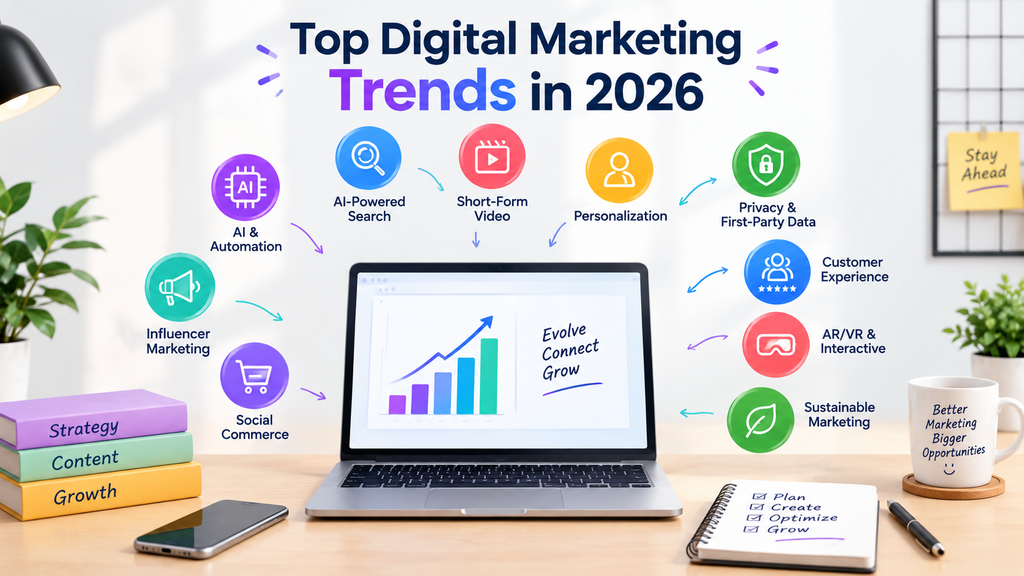
1. Artificial Intelligence Is Transforming Digital Marketing
Artificial intelligence is one of the biggest digital marketing trends in 2026.
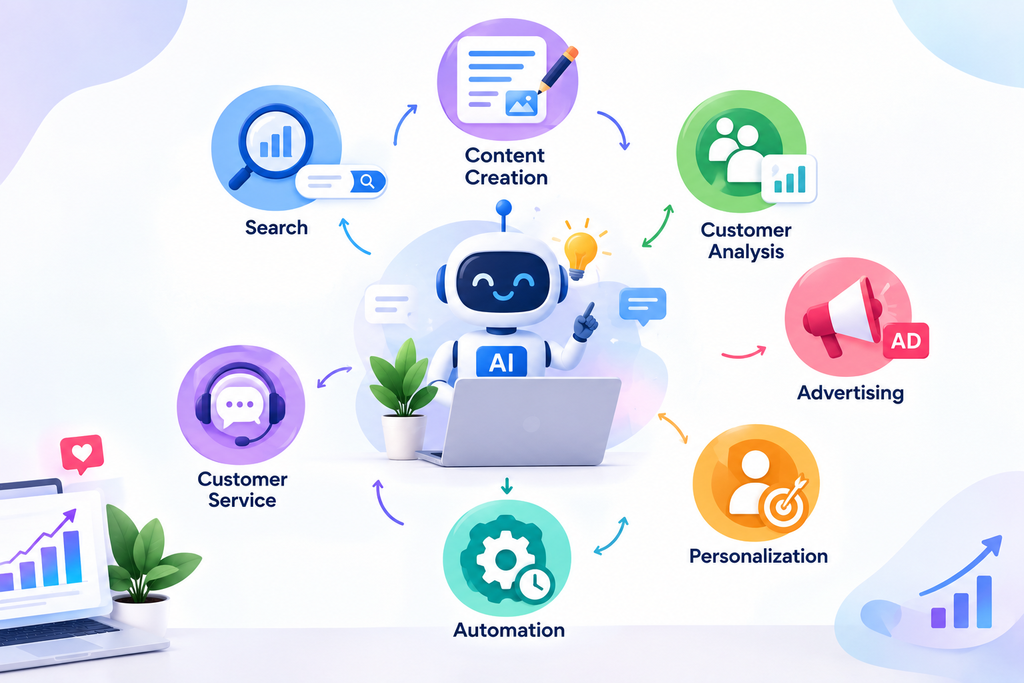
AI is being used across content creation, advertising, customer service, analytics, search, personalization, and marketing automation. Instead of using AI for only one task, businesses are increasingly integrating it into broader marketing workflows.
Marketers can use AI to:
- Generate content ideas
- Analyze customer data
- Create advertising variations
- Personalize customer experiences
- Automate repetitive tasks
- Predict customer behavior
- Improve campaign analysis
- Assist with customer support
Google’s 2026 marketing guidance describes AI as increasingly influencing discovery, advertising, commerce, and marketing operations.
The important point is that AI should support human strategy rather than replace it. Good marketing still requires creativity, brand understanding, original ideas, and knowledge of the target audience.
2. AI-Powered and Conversational Search
Search is becoming one of the most significant digital marketing trends to watch.
Traditional search often involved typing a few keywords into a search engine. AI-powered search allows users to ask longer and more detailed questions using natural language.
Google reports that AI Mode queries can be significantly longer than traditional queries and that search is becoming increasingly conversational, multimodal, and capable of handling more complex user intent.
This creates new opportunities for businesses.
How Businesses Can Adapt
Businesses should:
- Create helpful, people-first content.
- Answer specific customer questions.
- Build topical authority.
- Use clear headings and structured content.
- Include useful FAQs.
- Provide original information and insights.
- Create content that addresses different stages of the customer journey.
SEO is therefore not disappearing. Instead, it is expanding into a broader approach that includes traditional search, conversational search, visual discovery, and AI-generated answers.
3. Short-Form Video Remains a Powerful Marketing Format
Video continues to be one of the most important digital marketing trends.
Short-form videos are widely used for product discovery, education, entertainment, tutorials, reviews, and brand storytelling.
Platforms such as YouTube, Instagram, and TikTok allow businesses to communicate with audiences through quick and visually engaging content.
Businesses can create:
- Product demonstrations
- Educational videos
- Customer testimonials
- Behind-the-scenes videos
- Quick tips
- Frequently asked question videos
- Before-and-after videos
- Short tutorials
Video is also becoming useful across more stages of the customer journey. Google notes that people use YouTube for purposes ranging from discovering something new to researching products and making decisions.
The key is not simply producing more videos. Businesses should create videos that provide value and match the interests of their target audience.
4. Personalization Is Becoming More Important
Personalization is another major development among digital marketing trends.
Customers are exposed to thousands of marketing messages. Generic communication can easily get ignored.
Personalization allows businesses to make content, recommendations, emails, advertisements, and offers more relevant to individual users.
Examples include:
- Personalized email campaigns
- Product recommendations
- Customized website content
- Location-based offers
- Personalized advertisements
- Recommended articles
- Abandoned-cart messages
Effective personalization should be useful rather than intrusive.
Businesses also need to pay attention to privacy and consent when collecting and using customer information. The goal should be to create more relevant experiences while maintaining customer trust.
5. First-Party Data and Privacy-First Marketing
Privacy is becoming increasingly important within digital marketing trends.
Customers want useful experiences, but they also want greater transparency about how their information is collected and used.
First-party data can help businesses understand customers while building a more direct relationship with their audiences.
Examples of first-party data include:
- Website interactions
- Email subscriptions
- Customer purchases
- Account information
- Customer feedback
- Loyalty program activity
Businesses should explain their data practices clearly and collect information responsibly.
A privacy-first strategy can help create stronger relationships because customers are more likely to trust businesses that are transparent about their practices.
6. Creator and Influencer Marketing Is Evolving
Creator marketing continues to develop and is an important part of digital marketing trends.
Instead of focusing only on influencers with enormous follower counts, businesses are increasingly interested in creators with relevant communities and strong audience relationships.
Micro and niche creators can be useful because they often focus on specific subjects or audiences.
Businesses can work with creators to produce:
- Product reviews
- Tutorials
- Demonstrations
- Educational content
- Sponsored videos
- User-generated content
- Brand storytelling
Google’s 2026 marketing outlook highlights creators as an increasingly important part of creative strategy and community engagement.
Authenticity is particularly important. Audiences can often recognize content that feels overly promotional, so successful creator partnerships should provide genuine value.
7. Social Commerce Is Bringing Marketing and Shopping Together
Social commerce is another important area within digital marketing trends.
Social media is no longer used only for entertainment and communication. It can also influence product discovery, research, and purchasing decisions.
Social commerce can include:
- Shoppable posts
- Product tags
- Creator recommendations
- Live shopping
- Product videos
- Social media storefronts
- Direct purchasing experiences
This can shorten the distance between discovering a product and purchasing it.
For businesses, social commerce creates an opportunity to combine content, community, product discovery, and sales within connected customer experiences.
8. Customer Experience Is Becoming a Marketing Priority
Customer experience is one of the most important long-term digital marketing trends because customers do not judge a business only by its advertisements.
They also consider:
- Website experience
- Mobile usability
- Customer support
- Checkout experience
- Communication
- Delivery updates
- Personalization
- Brand consistency
A business may have excellent advertising but still lose customers if its website is slow or its buying process is confusing.
Modern marketing therefore needs to consider the entire customer journey.
AI chatbots, automation, personalization, analytics, and omnichannel communication can improve experiences when they are implemented thoughtfully.
9. Interactive and Immersive Marketing Experiences
Interactive experiences are becoming another interesting area among digital marketing trends.
Instead of simply showing customers advertisements, businesses can encourage them to interact with products or brand experiences.
Examples include:
- Augmented reality product previews
- Virtual try-ons
- Interactive quizzes
- 360-degree product views
- Interactive calculators
- Virtual experiences
- Interactive product demonstrations
These experiences can make marketing more engaging because customers become active participants rather than passive viewers.
As technology becomes easier to use, interactive marketing could become more accessible to businesses of different sizes.
10. Sustainable and Responsible Marketing
Sustainability and responsible communication are also becoming relevant digital marketing trends.
Customers increasingly encounter environmental and social claims from brands. This makes transparency important.
Businesses should avoid vague or exaggerated claims and instead communicate specific, understandable benefits.
Responsible marketing can include:
- Clear product information
- Evidence-based environmental claims
- Transparent communication
- Responsible advertising
- Ethical use of customer data
- Honest influencer partnerships
Google’s 2026 marketing outlook emphasizes communicating tangible sustainability benefits rather than relying on broad claims.
The broader lesson is simple: marketing claims should be supported by what a business actually does.
How Digital Marketing Trends Are Changing Consumer Behavior
The biggest digital marketing trends are closely connected to changes in consumer behavior.
People now move between search engines, social media, video platforms, websites, shopping platforms, and AI tools during the same buying journey.
Google’s 2026 research describes consumers as moving through search, video, social and shopping experiences while AI increasingly helps them explore and make decisions.
Consumers increasingly expect:
- Fast answers
- Useful content
- Personalized experiences
- Convenient shopping
- Authentic recommendations
- Easy communication
- Relevant video content
- Greater transparency
This means businesses need to think beyond individual marketing channels and focus on the complete customer journey.
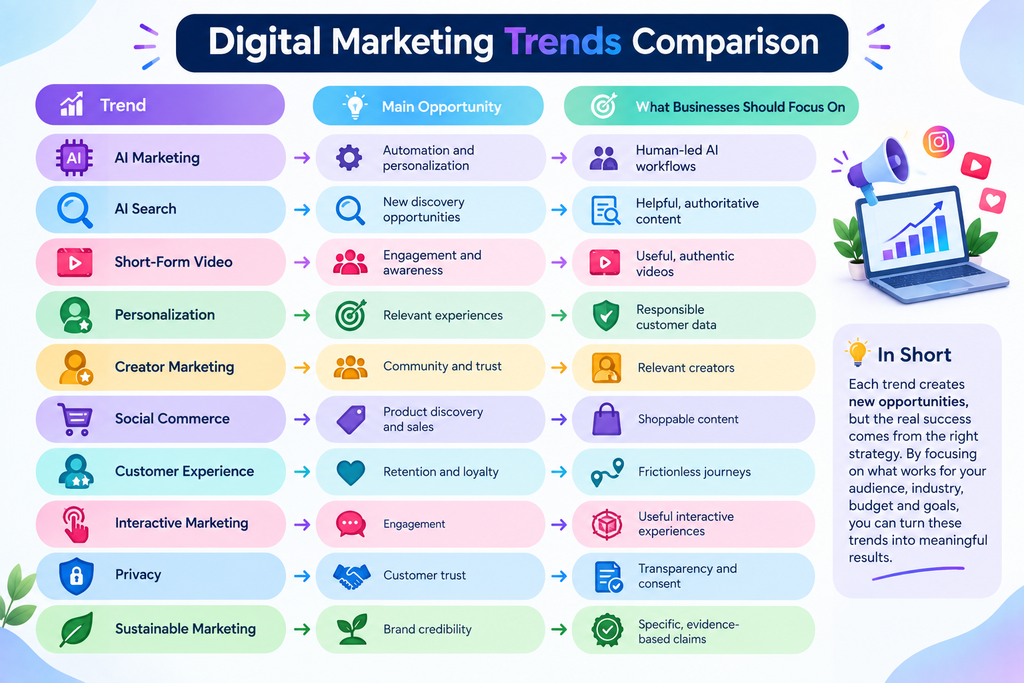
Digital Marketing Trends Comparison
| Trend | Main Opportunity | What Businesses Should Focus On |
| AI marketing | Automation and personalization | Human-led AI workflows |
| AI search | New discovery opportunities | Helpful, authoritative content |
| Short-form video | Engagement and awareness | Useful, authentic videos |
| Personalization | Relevant experiences | Responsible customer data |
| Creator marketing | Community and trust | Relevant creators |
| Social commerce | Product discovery and sales | Shoppable content |
| Customer experience | Retention and loyalty | Frictionless journeys |
| Interactive marketing | Engagement | Useful interactive experiences |
| Privacy | Customer trust | Transparency and consent |
| Sustainable marketing | Brand credibility | Specific, evidence-based claims |
How Businesses Can Adapt to Digital Marketing Trends
Following digital marketing trends does not mean changing your entire marketing strategy every few months.
Instead, businesses should use a structured approach.
1. Understand Your Audience
Find out:
- What customers search for
- Which platforms they use
- What content they consume
- What problems they want to solve
- What influences their purchasing decisions
2. Select Relevant Trends
Not every trend will work for every business.
A local service business may benefit more from local SEO, reviews, useful content, and short videos than from an expensive immersive campaign.
3. Experiment With Small Campaigns
Test one idea before investing heavily.
For example, a business could test:
- Five short videos
- An AI-assisted content workflow
- A personalized email campaign
- A creator collaboration
- A new landing page
4. Measure Results
Important marketing metrics include:
- Website traffic
- Engagement rate
- Leads
- Conversion rate
- Customer acquisition cost
- Return on investment
- Customer retention
Data should determine whether a new strategy is worth expanding.
5. Keep the Human Element
Technology can improve speed and efficiency, but human creativity remains important.
Strong marketing combines technology with:
- Creativity
- Empathy
- Strategy
- Storytelling
- Brand identity
- Customer understanding
Future Digital Marketing Trends to Watch
The future of digital marketing trends will likely involve deeper integration between AI, search, content, commerce, and customer experiences.
Some developments worth watching include:
- AI agents that assist customers with decisions
- Conversational search
- Multimodal search using text, images, video, and voice
- Generative Engine Optimization
- AI-powered content production
- Creator-led communities
- Personalized customer journeys
- Agentic commerce
- Advanced marketing automation
- Privacy-focused measurement
Google’s 2026 marketing guidance describes an increasingly “agentic” web in which AI assistants can play a larger role in product discovery and purchasing.
For marketers, this means being prepared for customers to interact with brands through new interfaces rather than relying only on traditional websites and search results.
Frequently Asked Questions About Digital Marketing Trends
What are the biggest digital marketing trends in 2026?
Some of the major digital marketing trends in 2026 include artificial intelligence, AI-powered search, short-form video, personalization, creator marketing, social commerce, customer experience, privacy-first marketing, and interactive experiences.
How is AI changing digital marketing?
AI is helping marketers with content creation, customer analysis, advertising, personalization, automation, search, and customer service. It can reduce repetitive work and help businesses respond to customer needs more efficiently.
Is SEO still important in 2026?
Yes. SEO remains important, but the search environment is changing. Businesses should create useful, authoritative content that can satisfy traditional searches as well as conversational and AI-powered discovery.
Which trends in digital marketing should small businesses concentrate on?
Small businesses can focus on trends that are practical and affordable, such as local SEO, short-form video, helpful content, email marketing, customer reviews, social media, personalization, and selective AI automation.
Why is personalization important?
Personalization helps businesses provide more relevant content, recommendations, offers, and communication. However, it should be implemented responsibly and with appropriate attention to customer privacy.
Conclusion
The world of digital marketing trends is changing rapidly, but the fundamental goal of marketing remains the same: understanding customers and providing something useful to them.
In 2026, AI is changing search and marketing workflows, video continues to influence discovery, creators are helping brands build communities, and personalization is becoming more important.
At the same time, privacy, authenticity, customer experience, and responsible communication remain essential.
Businesses do not need to adopt every new technology or follow every trend. Instead, they should identify the digital marketing trends that fit their customers and business goals.
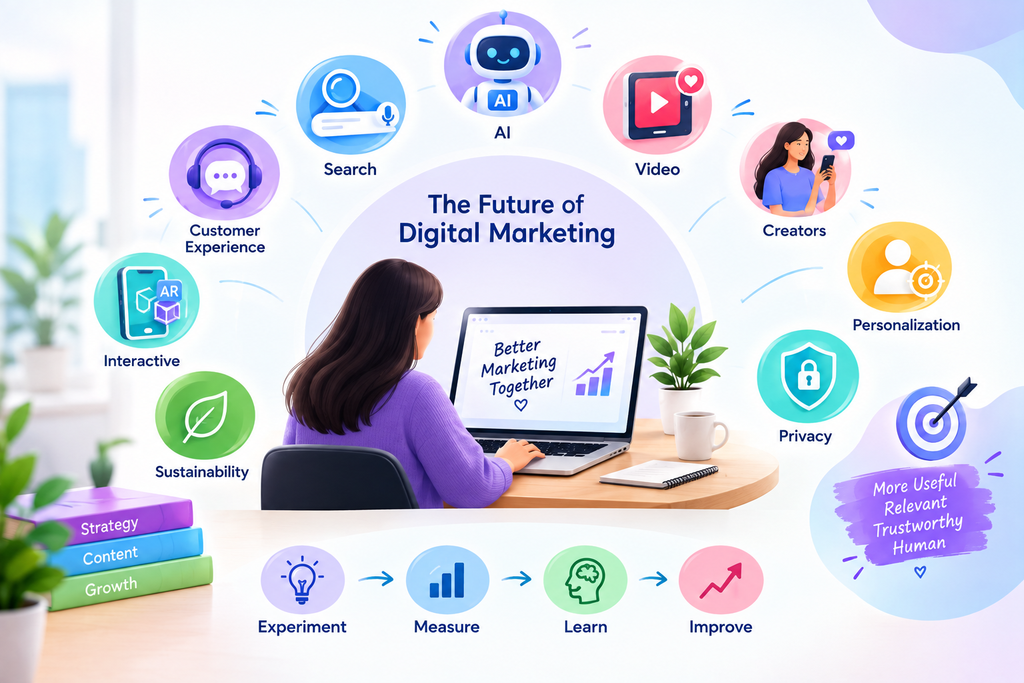
The most effective approach is to experiment, measure results, learn from customer behavior, and continuously improve.
The future of marketing will belong not simply to businesses that adopt the newest technology, but to businesses that use technology to create more useful, relevant, trustworthy, and human customer experiences.
Pingback: Google Ads in digital marketing : A complete Guide