
Table of Contents
Introduction
Running a successful Google Ads campaign starts with choosing the right keywords. Keywords help connect your advertisements with people who are actively searching for products or services like yours. However, selecting random or highly searched keywords can waste your advertising budget.
This is why understanding How to Do Keyword Research for Google Ads is important for every advertiser. Proper keyword research helps you identify relevant search terms, understand customer intent, and create advertisements that reach the right audience.
Whether you are a beginner or an experienced marketer, learning how to find and organize keywords can improve your campaign performance. In this guide, we will explore the complete process, useful tools, and practical tips for effective keyword research.
What Is Keyword Research for Google Ads?
Keyword research for Google Ads is the process of finding and analyzing search terms that potential customers use when looking for specific products, services, or information.
These keywords help advertisers decide when their ads should appear on Google Search.
For example, if you own a digital marketing agency, you might target keywords such as:
- Digital marketing services
- SEO services near me
- PPC management agency
- Social media marketing company
- Website development services
Unlike SEO keyword research, which focuses on improving organic search visibility, Google Ads keyword research focuses on identifying relevant searches that can generate paid clicks and conversions.
Understanding How to Do Keyword Research for Google Ads allows businesses to target relevant searches instead of spending money on unrelated traffic.
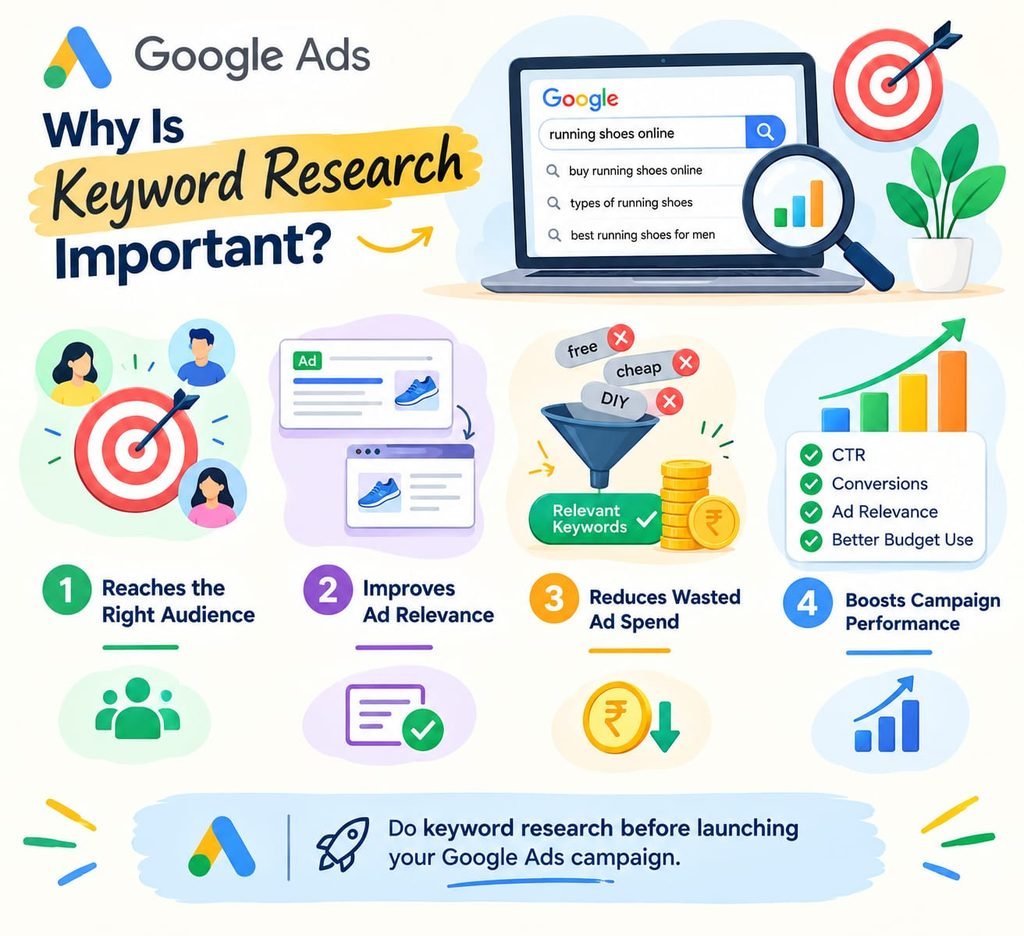
Why Is Keyword Research Important for Google Ads?
Keyword research plays an important role in creating effective advertising campaigns. Choosing relevant keywords helps businesses reach potential customers while managing their advertising budgets.
Here are some major benefits:
1. Helps Reach the Right Audience
Relevant keywords connect your advertisements with people who are already interested in your products or services.
For example, someone searching for “buy running shoes online” has a different requirement from someone searching for “types of running shoes.”
Targeting specific searches helps you reach people who are more likely to take action.
2. Improves Ad Relevance
When your keywords match your advertisement and landing page, users receive more relevant information.
This improves the overall advertising experience and can contribute to better campaign performance.
3. Reduces Wasted Advertising Spend
Using irrelevant keywords can attract visitors who are not interested in your offerings.
Keyword research helps identify unnecessary search terms and allows advertisers to exclude them through negative keywords.
4. Supports Better Campaign Performance
The right keywords can help improve:
- Click-through rates
- Conversion opportunities
- Ad relevance
- Budget utilization
- Overall campaign effectiveness
Therefore, keyword research should be completed before launching any Google Ads campaign.
How to Do Keyword Research for Google Ads: Step-by-Step Guide
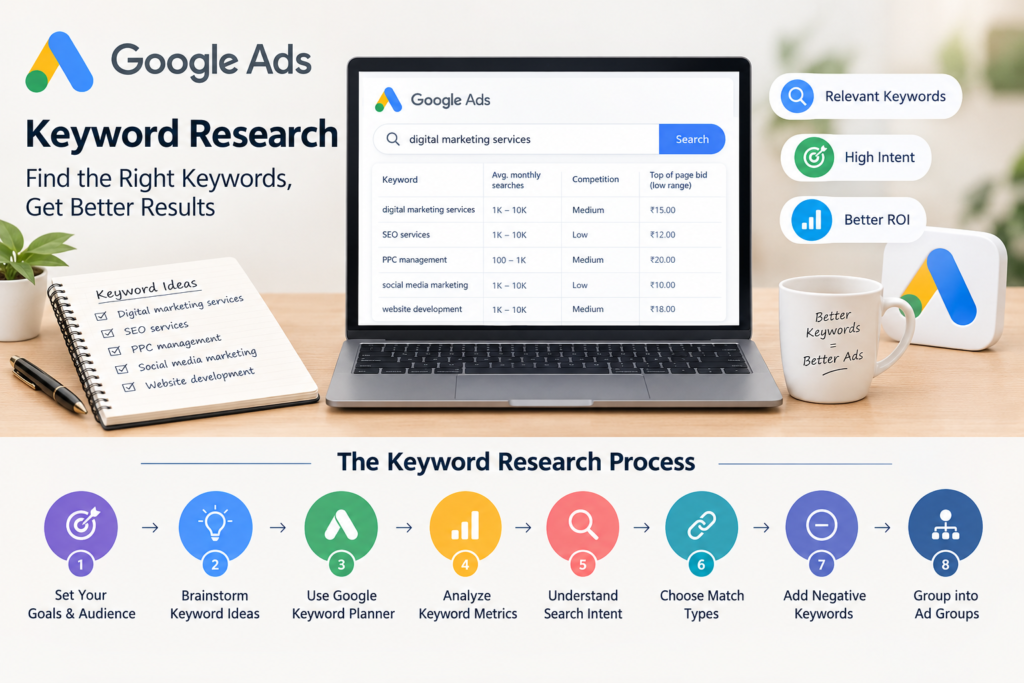
Understanding the correct process makes keyword research easier and more effective. Follow these steps to find suitable keywords for your advertising campaigns.
Step 1: Understand Your Business Goals and Target Audience
Before searching for keywords, understand what you want to achieve through Google Ads.
Your advertising goals may include:
- Generating website traffic
- Increasing product sales
- Getting more leads
- Promoting a particular service
- Increasing brand awareness
Next, identify your target audience.
Consider their location, interests, problems, and purchasing behavior.
For example, if you provide digital marketing services in India, your target audience might include small business owners, startups, and local businesses looking for online marketing solutions.
Understanding your audience helps you select keywords that match their requirements.
Step 2: Brainstorm Initial Keyword Ideas
Start by creating a list of words and phrases related to your business.
Think about what customers would type into Google when searching for your products or services.
For a digital marketing agency, initial keyword ideas could include:
- Digital marketing agency
- SEO services
- Google Ads management
- Social media marketing
- Content marketing services
- Website design agency
You can also consider different keyword variations, such as:
| Keyword Type | Example |
| Service-based | SEO services |
| Location-based | SEO services in Chandigarh |
| Problem-based | How to increase website traffic |
| Commercial | Best digital marketing agency |
| Transactional | Hire SEO expert |
This brainstorming process creates a starting point for further keyword analysis.
Step 3: Use Google Keyword Planner
Google Keyword Planner is one of the most useful tools for conducting keyword research for Google Ads.
It helps advertisers discover keyword ideas, understand search trends, and explore estimated advertising costs.
To use Google Keyword Planner:
- Open Google Ads and sign in to your account.
- Navigate to the Tools section.
- Select Keyword Planner.
- Choose “Discover new keywords.”
- Enter relevant keywords or a website URL.
- Review the keyword suggestions.
- Analyze search volume, competition, and bid estimates.
Google Keyword Planner provides two main options:
Discover New Keywords: Helps you find related keyword ideas based on your products, services, or website.
Get Search Volume and Forecasts: Provides historical search information and performance forecasts for selected keywords.
For example, entering “digital marketing services” may generate related keyword suggestions such as SEO agency, PPC services, and online marketing company.
These suggestions help you discover additional opportunities for your campaigns.
Step 4: Analyze Keyword Metrics
Finding keyword ideas is not enough. You also need to analyze their performance potential.
When learning How to Do Keyword Research for Google Ads, understanding keyword metrics is essential for selecting suitable search terms.
Important metrics include:
1. Average Monthly Searches
This indicates the average number of searches for a keyword over a specific period.
Keywords with higher search volume may provide more opportunities, but they are not always the best choice.
2. Competition
Google Keyword Planner provides competition information based on advertiser activity.
High competition may indicate that many advertisers are bidding on a particular keyword.
3. Top-of-Page Bid Estimates
These estimates provide an idea of the bid amounts advertisers may need to appear near the top of search results.
Actual costs can vary depending on several factors.
4. Keyword Relevance
A keyword should directly relate to your product, service, or advertising objective.
For example, an SEO agency should prioritize “SEO services” over unrelated terms such as “free graphic design software.”
Step 5: Understand Search Intent
The motivation behind a user’s search query is referred to as search intent.
Understanding search intent helps advertisers select keywords that match customer expectations.
There are four common types of search intent:
| Search Intent | Meaning | Example |
| Informational | Looking for information | What is SEO? |
| Navigational | Finding a specific website | Google Ads login |
| Commercial | Comparing available options | Best SEO agency |
| Transactional | Ready to take action | Hire SEO expert |
For advertising campaigns, commercial and transactional keywords can be especially valuable because they may indicate stronger purchasing interest.
However, when the goal of the campaign is audience awareness or lead generation, informational keywords can also be helpful.
Always match your keyword selection with your campaign goals.
Step 6: Choose the Right Keyword Match Types
Keyword match types control how closely a user’s search needs to match your selected keywords before your advertisement can appear.
Google Ads provides three main keyword match types.
1. Broad Match
Broad match provides the widest reach. Your ads may appear for searches related to the meaning of your keyword.
Example:
digital marketing services
2. Phrase Match
Phrase match allows your ads to appear when users search for the main meaning of your keyword, even if they include additional words or change the word order slightly.
Example:
“digital marketing services”
3. Exact Match
Exact match provides more control over the searches that can trigger your advertisements.
Example:
[digital marketing services]
Comparison of Keyword Match Types
| Match Type | Reach | Control |
| Broad Match | Wider | Lower |
| Phrase Match | Moderate | Medium |
| Exact Match | More focused | Higher |
Choosing the right match type depends on your campaign goals, budget, and keyword strategy.
Step 7: Identify and Add Negative Keywords
Negative keywords prevent your advertisements from appearing for searches that are not relevant to your business.
For example, if you provide paid digital marketing services, you may want to exclude searches containing terms such as:
- Free
- Jobs
- Salary
- Internship
- Course
Suppose you are targeting the keyword “SEO services.”
You may not want your advertisement to appear when someone searches for “SEO jobs” or “free SEO course.”
Adding suitable negative keywords helps reduce irrelevant clicks and improve campaign targeting.
Review your search terms report regularly to identify additional irrelevant queries.
Step 8: Group Keywords into Relevant Ad Groups
After selecting your keywords, organize them into relevant groups.
Grouping similar keywords makes campaign management easier and helps you create more relevant advertisements.
For example, a digital marketing agency can organize its keywords as follows:
| Ad Group | Keywords |
| SEO Services | SEO services, SEO agency |
| PPC Services | PPC management, Google Ads agency |
| Social Media Marketing | SMM services, social media agency |
| Website Development | Website design, website development services |
Each ad group should contain closely related keywords.
Your advertisements and landing pages should also match the keywords within each group.
This creates a more consistent experience for potential customers.
Best Keyword Research Tools for Google Ads
You can find new advertising chances and simplify keyword research by using the appropriate tools.
Here are some useful tools:
1. Google Keyword Planner
Google Keyword Planner is a popular tool for discovering keyword ideas, reviewing search volume, and exploring advertising bid estimates.
It is especially helpful for preparing campaigns.
2. Semrush Keyword Magic Tool
Semrush Keyword Magic Tool helps users discover keyword variations, related searches, and long-tail keywords.
It can also help advertisers explore keyword opportunities based on specific topics.
3. Google Search Suggestions
Google Search Suggestions provide ideas based on common searches entered by users.
You can enter your main keyword into Google and review the suggested searches for additional keyword inspiration.
4. Competitor Website Analysis
Analyzing competitor websites can help you understand the services and topics they focus on.
Look for relevant products, service categories, and customer-focused phrases that may provide useful keyword ideas.
Common Mistakes to Avoid During Google Ads Keyword Research
Even with useful tools, advertisers can make mistakes that negatively affect campaign performance.
Avoid these common keyword research mistakes:
- Choosing only high-volume keywords: Popular keywords may not always attract relevant customers.
- Ignoring search intent: Keywords should match what users actually want.
- Using too many broad keywords: This may attract irrelevant search queries.
- Forgetting negative keywords: Unrelated searches can consume your advertising budget.
- Mixing unrelated keywords: Different services should be organized into suitable ad groups.
- Ignoring keyword costs: Consider your advertising budget before selecting competitive keywords.
- Not reviewing performance: Regular monitoring helps identify keywords that need improvement.
Avoiding these mistakes makes your keyword strategy more focused and effective.
Tips for Improving Your Google Ads Keyword Research
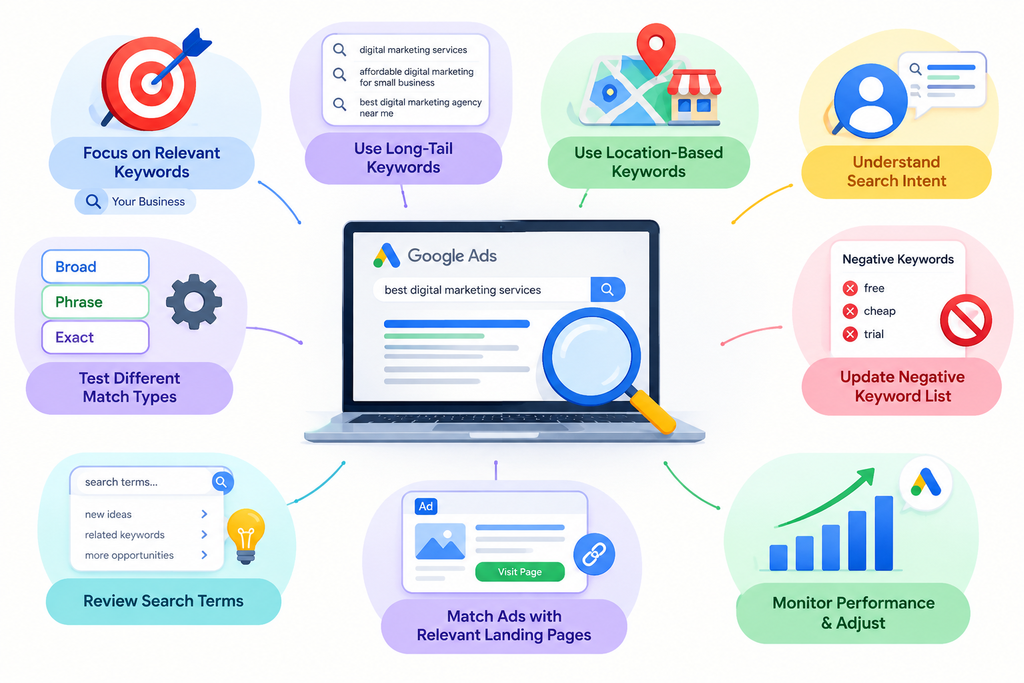
Here are some practical tips to improve your keyword selection process:
- Concentrate on terms that are directly relevant to your company.
- Include long-tail keywords to target more specific searches.
- Use location-based keywords when advertising local services.
- Analyze search intent before adding keywords.
- Test different keyword match types.
- Regularly update your negative keyword list.
- Review search terms to discover new opportunities.
- Match your advertisements with relevant landing pages.
- Monitor campaign performance and make necessary changes.
Remember, effective keyword research is an ongoing process rather than a one-time activity.
Conclusion
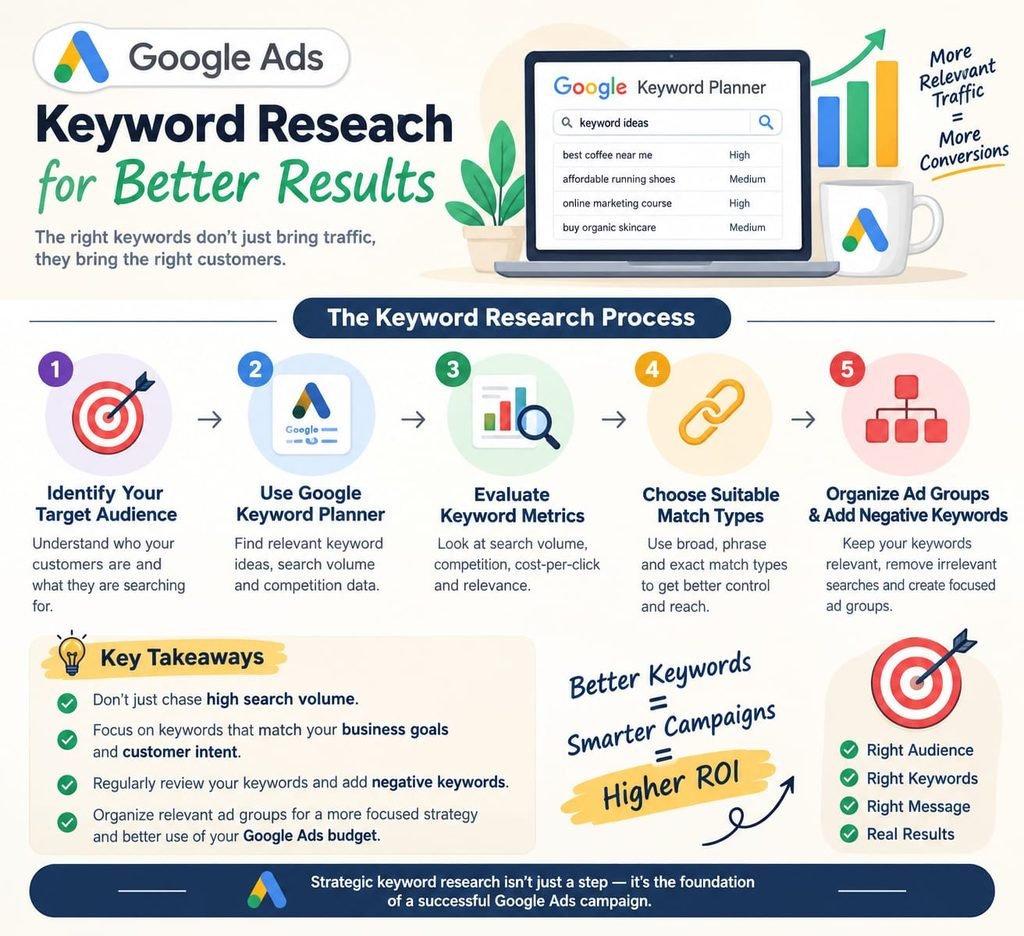
Developing relevant and successful advertising campaigns requires understanding How to conduct keyword research for Google Ads. Every stage of the process, from identifying your target audience to utilizing Google Keyword Planner, evaluating keyword metrics, and choosing suitable match types, helps to improve campaign planning.
The main goal is not simply to find keywords with high search volume. Instead, focus on keywords that match your business goals and customer intent.
By regularly reviewing your keywords, adding negative keywords, and organizing relevant ad groups, you can create a more focused advertising strategy and make better use of your Google Ads budget.
Frequently Asked Questions (FAQs)
1. How do I find the right keywords for Google Ads?
Understanding your target market and business objectives should come first. Brainstorm relevant keyword ideas, use Google Keyword Planner, analyze search volume and competition, and select keywords that match your campaign objectives.
2. Is Google Keyword Planner free to use?
Google Keyword Planner is available through Google Ads. You can use it to discover keyword ideas, review search information, and explore advertising forecasts. Access to some data may depend on your account and advertising activity.
3. What are the finest keywords for Google? What are the best keywords?
The ideal keywords fit the search intent of your target market and are pertinent to your goods or services. Campaigns aimed at producing leads and sales may benefit from using commercial and transactional keywords.
4. How many keywords should I use in a Google Ads campaign?
There is no fixed number of keywords suitable for every campaign. Focus on selecting relevant keywords and organizing them into closely related ad groups rather than adding a large number of unrelated terms.
5. What is the difference between SEO keywords and Google Ads keywords?
SEO keywords are used to improve a website’s organic search visibility, while Google Ads keywords help advertisers target relevant searches through paid advertisements. Both require keyword research, but their campaign objectives are different.
6. Why are negative keywords important in Google Ads?
Negative keywords aid in keeping ads from showing up for unrelated queries. They improve targeting, reduce unnecessary clicks, and help advertisers manage their advertising budgets more effectively.